Ask your unstructured data anything with LAKEer.Get the most trustworthy answers in seconds.
LAKEer turns plain-English questions into verified answers from PDFs, Office docs, emails, and Teams/Slack. LAKEer achieved the highest score ever published on Google DeepMind's FACTS Benchmark.
And with developer tools that automatically keep LAKEer in sync with document additions and deletions, evolving business terminology, and changes to your domain knowledge.
50 queries/month free · No credit card
Most Trustworthy Answers
LAKEer is #1 on the FACTS Grounding Benchmark — Google DeepMind's gold standard for measuring how accurately AI grounds answers in source documents.
Automatic Sync
LAKEer example: A source document is deleted. LAKEer automatically removes it from future answers — no stale citations.
- WCR-Q3-014.pdf
- WCR-Q3-022.pdf
- WCR-Q3-031.pdf
- WCR-Q3-014.pdf
- WCR-Q3-022.pdf
- WCR-Q3-031.pdf
Plus: schema changes, new documents, evolving business terminology — all kept in sync automatically.
How Does LAKEer Work?
Get started in five simple steps
Add Domain Knowledge
Plug in a DaaX Domain Knowledge Cartridge to ground LAKEer in your industry.
Add Company Language
Teach LAKEer the acronyms, project names, and terminology your organization uses.
Ingest Your Documents
Connect your unstructured data sources to LAKEer.
Test and Refine
Ask questions in natural language and tune the results.
Integrate through the API / MCP
Add natural language search to your applications via the LAKEer API / MCP.
Automatic Sync
Keeps LAKEer aligned as your documents, domain knowledge, and company language evolve.
Superior Answers vs. LLMs Only
LLMs need a helping hand because they hallucinate, don't understand your domain, and don't understand your company language
| LLM Limitation | LAKEer |
|---|---|
Hallucinations | |
Don't Have Domain Knowledge | Has Domain Knowledge via Pluggable Domain Knowledge Cartridges |
Don't Understand Company Language | Understands Company Language via Pluggable Company Language Cartridges |
Three things that are not a DaaX 3D graph
Not a Vector Index. Not a Fine-Tuned Model. Not a Rules Engine.
Each of these solves a real problem. None of them can answer a constraint question correctly and provably.
A vector index — RESEMBLES
It finds text that reads like the question. A passage can resemble a perfect match while being wrong on the facts, and similarity alone has no way to catch that.
A fine-tuned model — MEMORIZES
It bakes a snapshot of your knowledge into its weights. When a spec or a policy changes, the snapshot goes stale, and there's no way to tell which parts.
A rules engine — ENUMERATES
It encodes the cases someone anticipated. Real question spaces are combinatorial — the cases nobody anticipated are exactly the ones people ask about.
A DaaX 3D graph reasons — that's the whole difference.
LAKEer still uses vector and keyword search; they're among its retrieval channels. The graph sits above them, borrowing from both and adding the two things neither has on its own: typed relationships and per-claim provenance.
How LAKEer Gives a Helping Hand to LLMs
LAKEer gives LLMs the domain ontologies, company vocabulary, knowledge graph structure, and verified evidence they need to generate answers your team can trust. It also keeps this context in sync as your documents and business terminology evolve. Every setup step is available two ways — through the Developer Dashboard UI or programmatically via the API — and in production, your application asks questions through the LAKEer API.
PDFs, Office, Email, Teams & Slack
Audit Trail + Math Over Data
Single-tenant security
REST API + MCP Server
Step 1 — Add Domain Knowledge
Domain Knowledge Cartridges
Plug in a cartridge that encodes your industry's ontology, terminology, and relationships so LAKEer interprets documents against a structured domain model rather than an open-ended guess.
Cartridges available today from DaaX include General Purpose, OSDU Ontology (Oil & Gas), and Good Relations (Agentic Commerce). Cartridge from DaaX Partners available soon. Want to create your own Cartridge? Yes, you can do that! Contact us for details.
Step 2 — Add Company Language
Company Language Cartridges
Every company has its own language — product names, internal acronyms, industry shorthand. Company Language Import lets you teach that language to LAKEer once, then package it as a reusable Cartridge that travels with your data.
And because it's built on open standards, your vocabulary is never locked into LAKEer. Company Language Import uses SKOS (Simple Knowledge Organization System), the W3C standard for controlled vocabularies.
Aliases, preferred terms, and broader/narrower relationships all follow the same model used across the semantic web — so the vocabulary you build is portable and interoperable, usable in any SKOS-aware system, not just DaaX.
Governed Vocabulary — No Schema Drift
Think of your company's vocabulary like a dictionary that's constantly being edited by different people. Left unmanaged, dictionaries like that get messy fast: someone adds a new entry for a word that already exists under a slightly different spelling, someone else defines a word in a way that contradicts an existing entry three pages over, and pretty soon nobody's sure which definition is the "real" one.
That slow decay is what we mean by schema drift — the vocabulary technically still works, but it's quietly stopped being trustworthy.
LAKEer prevents the structural version of this problem automatically. Every time a new term gets added, the system checks it against the rules of your existing vocabulary before it's allowed in: does this term already exist under this exact name? Does the relationship it's claiming (e.g., "this is a type of that") actually make sense, or does it contradict something already on record? Is it properly connected to the rest of the vocabulary, or is it just floating on its own with no way to find it later?
A term that fails any of those checks gets rejected before it ever reaches your knowledge graph — so the vocabulary can keep growing for years without turning into a mess.
Step 3 — Ingest Your Documents
Batch and Incremental Ingestion
Ingest a full batch of documents at once, or add them one at a time — the first is a full ingest, every subsequent document is incremental.
No full rebuild when a new contract arrives. Reset controls let you clear an index and graph cleanly before starting fresh.
Ontology-Guided 3D Graph Construction
LAKEer doesn't just chunk and embed. Content is extracted from your documents and organized into a knowledge graph guided by your active cartridge — so relationships between vendors, contracts, obligations, and terms are captured as structure, not just similar-looking text.
This is a meaningfully different approach from open graph-extraction tools like Microsoft's GraphRAG, which let an AI model freely decide what counts as an entity and how things relate, with no predefined structure to check against. That's flexible, but it means the same real-world thing can end up represented two different ways in the graph — a "sensor" in one document and a "detector" in another, with nothing telling the system they're the same kind of object — because there's no schema constraining what gets extracted or how.
LAKEer's cartridges provide that schema: every extraction is checked against your ontology's defined types and relationships as it happens, so "vendor," "contract," and "obligation" mean the same specific thing everywhere they show up in your knowledge graph, not just wherever the text happened to look similar.
Tables Treated as Tables
Unlike most RAG pipelines that flatten spreadsheets into lossy text, LAKEer routes tabular content to purpose-built storage based on its shape.
It stores numeric values as true numbers — which is how it distinguishes a $500,000 liability cap from the $5,000 and $25,000 SLA penalties in the same document set.
Document Inventory
Document Inventory gives you a live, auditable view of every source ingested into LAKEer — every document listed with its page count, ingestion date, and how it was parsed. Delete a file before indexing, or remove one at any time. No black-box corpus, no stale citations.
Step 4 — Test and Refine
Multimodal Understanding
Coming SoonA single answer can draw on more than one part of a document at once — a table, an image, and the surrounding prose — rather than treating each as a separate, disconnected source.
Tables Treated as Tables handles the structured side; multimodal understanding is what lets an answer combine that with what's in an image or diagram and what the narrative text says around it.
Complex Query Decomposition
Real business questions aren't single lookups. LAKEer decomposes a complex question into a plan of sub-queries, routes each to the right retrieval channel or deterministic compute engine, then composes and verifies the final answer before it reaches you.
▸Show example
User asks:
"What was the total deal size for the West region, and what individual deals contributed to that total?"
LAKEer decomposes it into:
| # | Sub-query | Route |
|---|---|---|
| 1 | Aggregate deal size, filtered to the West region | Deterministic compute (SQL aggregation — not the LLM) |
| 2 | Retrieve the individual deal records that make up that total | Structured table retrieval |
Cross-Document Entity Synthesis
LAKEer can recognize when the same entity shows up in more than one document and bring what each one says together into a single answer.
If Document A establishes that John is a strong math student, and Document B separately notes that John is a good basketball player, LAKEer resolves both mentions to the same John and can answer with both facts together — not just whichever document it happened to retrieve first.
ClaimGuard
LAKEer doesn't trust its own first draft answer. ClaimGuardTM, LAKEer's answer-verification pipeline, decomposes every generated answer into individual claims and independently checks each one against the retrieved evidence before the answer reaches the user.
Claims that fail verification are corrected or regenerated — not passed through. So, when the evidence isn't there, LAKEer says so — instead of returning a plausible-sounding guess.
Every answer ships with a ClaimGuard verification log showing which claims are supported by your sources, with estimated (non-authoritative) values explicitly flagged. Your team always knows the difference between a sourced fact and an inference.
ClaimGuard doesn't only check claims against retrieved text. For cartridges that define their own domain-specific value patterns — for example, a valid price binding in the Agentic Commerce cartridge — ClaimGuard also checks that a claim's entity-value binding matches those patterns before the answer renders, catching a number that's present in a document but attributed to the wrong entity. As cartridges add their own patterns, this check gets stronger without any change to the underlying verification pipeline.
Read the ClaimGuard blog for a full breakdown.
Audit Trail on Every Answer
See the exact document, page, and table each part of an answer came from.
For example, when LAKEer says the liability cap is $500,000, it shows you the clause — and the lookalike numbers it correctly ruled out.
Mathematical Computations
Numeric values from tables and curves are stored as true numbers, enabling accurate mathematical comparison across documents — across wells and depths, SKUs and price lists.
LLMs treat numbers as text; LAKEer computes. Once in a database, DaaX SQLer can search it.
Step 5 — Integrate through the API
Query & Answer Caching
Ask the same or a similar question twice, and the second time is instant and costs nothing extra — repeated queries are served from a fast cache instead of re-running retrieval and generation from scratch.
Graph & Tabular Data Caching
We also cache the graph and tabular data, which accelerates processing of parts of a query even when it's not a repeat.
Follow-ups / Turn-by-Turn Conversations
Connects previous queries (turns) to the current one, based on conversation history we store.
Two Ways to Ask: Knowledge Mode and Grounded Mode
Every query can run in one of two modes. Grounded mode, the default, applies a strict constraint: every claim must trace directly to a specific retrieved passage, with no inference or extrapolation — well suited to specification lookups, compliance checks, and regulatory questions where precision matters more than completeness.
Knowledge mode synthesizes a comprehensive answer across all retrieved evidence — well suited to open-ended or comparative questions.
Both run through the same retrieval and verification pipeline; you can choose the mode per query if you want.
Multi-Lingual Questions
Ask questions in English, Spanish, Japanese, and more.
Ongoing after setup
Automatic Sync
LAKEer detects new, changed, and deleted documents on re-ingestion and updates the 3D graph, the vector index, and the structured tables together — so answers reflect the current version of a document, not a stale one.
Example Use Cases
Plus numerous others
Developer Resources
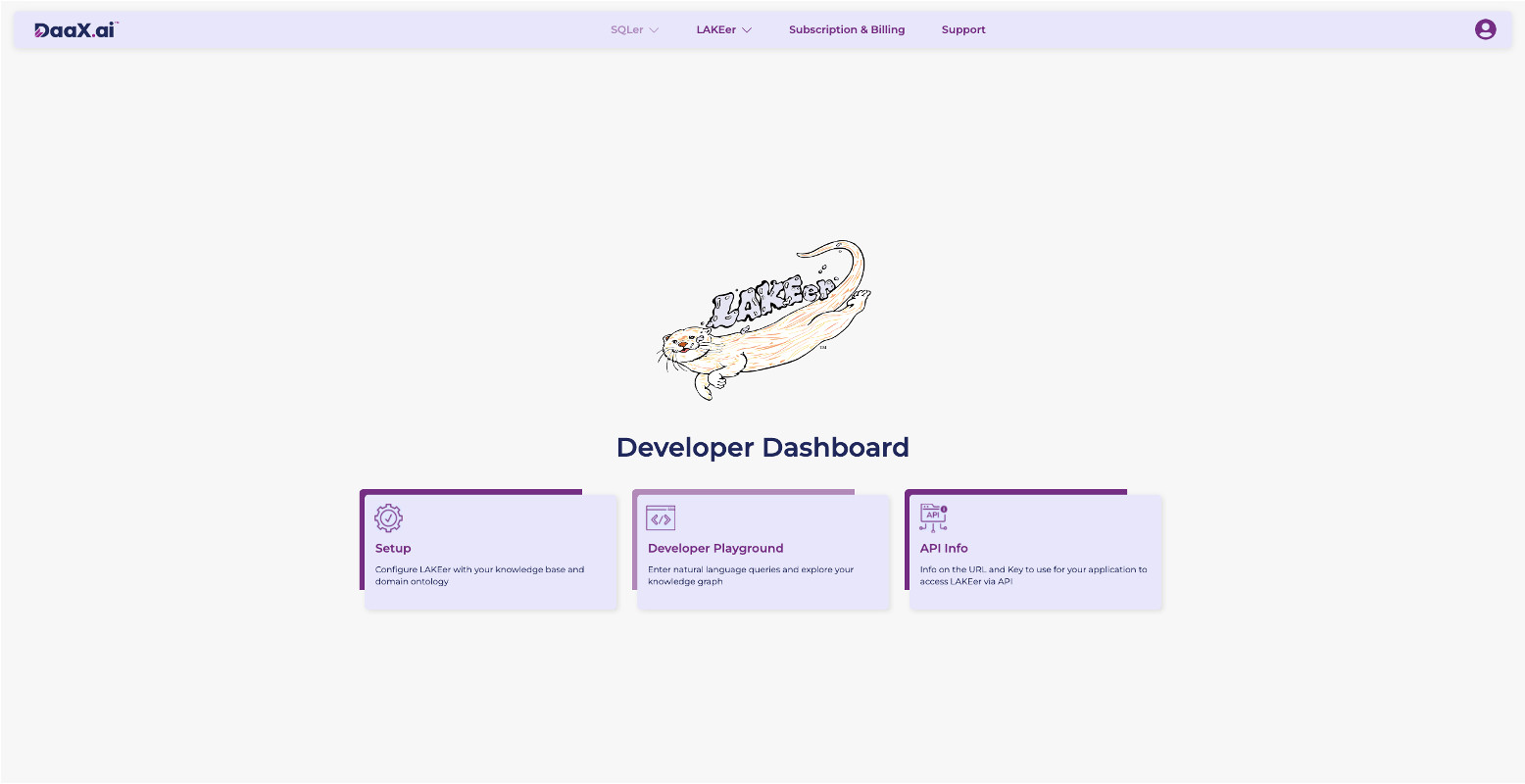
LAKEer Developer Dashboard contains everything you need to integrate it into your applications and workflows
Predictable Outcome-Based Pricing
Choose the plan that fits your needs. Transparent, predictable pricing.

DaaX LAKEer Pricing
Search your unstructured data with natural language
Free
Start Your Engine
50 queries/month | 25 pages ingested/month
Still Have Questions?
Schedule a free 15-minute consultation with our engineering team to discuss your specific needs