In January, Google and a coalition including Shopify, Target, and Walmart launched the Universal Commerce Protocol (UCP). UCP promises to make ecommerce easier with LLM and AI agents. For industrial distributors, it is also only half of what you need - and it is the easier half in my opinion.
On paper, UCP solves the classic friction points of digital shopping:
- Discoverability: Products syndicate cleanly into AI chat platforms like Google Gemini, Microsoft Copilot, and ChatGPT without messy web scraping.
- Cart Orchestration: A Universal Cart tracks items across multi-turn interactions, automatically applying bundle logic, volume discounts, and loyalty rules.
- Native Checkout: The Checkout Kit and tokenized payment protocols execute secure transactions directly within the conversation while keeping the merchant as the Merchant of Record.
For consumer retail like buying a pair of sneakers, a bag of coffee, or a camping tent, this architecture is a massive leap forward.
But for an industrial distributor selling fluid power, bearings, electrical gear, or heavy-duty replacement parts, that is exactly where the protocol stops.
UCP makes it frictionless to find an item, put it in a cart, and charge a credit card. What it cannot do is verify whether that part actually fits the machine waiting on the shop floor.
The Retail Illusion vs. the Industrial Reality
In consumer e-commerce, the cost of a buying mistake is negligible: a customer orders the wrong t-shirt size, prints a $12 return label, and ships it back.
In industrial distribution, the wrong part does not cost $12. It costs a production line:
- A maintenance technician orders an aftermarket compressor valve that matches the equipment model number, but fails on the specific serial number range or build revision.
- A customer orders a replacement bearing where the bore dimension looks identical on a phone note, but the part belongs to an inch R-series rather than a metric 6205 family.
- A hydraulic line is ordered with an inverted-flare fitting instead of a banjo fitting because both were described the same way over the phone.
Whether it is a valve, motor, bearing, electrical component, or other industrial spare part, when the wrong one arrives on site, the cost is never just the price of the part. The distributor absorbs outbound freight, return freight, warehouse restocking labor, and the cost of rushing a replacement shipment. The customer pays a technician to install the wrong part, pull it, and install the right one. Meanwhile, the production line or fleet vehicle sits idle. What remains is a dissatisfied customer and, where uptime or service-level commitments are in place, contractual exposure.
This is high-consequence commerce: buying the wrong product is expensive, potentially hazardous, operationally disruptive, or professionally catastrophic. Making bad purchases frictionless to execute does not help an industrial distributor. It simply accelerates the rate of error-attributable returns.
Why E-Commerce Search Breaks for Human Buyers of Industrial Products
Today, the vast majority of distributor revenue is driven by human buyers - plant engineers, fleet mechanics, and purchasing managers. Yet most industrial e-commerce sites hit a hard self-service ceiling.
When a contractor or mechanic visits an online catalog asking a technical spec question such as whether a replacement pump will mount to their existing frame size, or if a valve is rated for their supply pressure class, a traditional site search returns a ranked list of keywords rather than an engineering answer.
Because the buyer cannot verify the technical claim on the product page, one of two things happens:
- The sale walks. The buyer refuses to guess and leaves for a competitor who can confirm the specification, sometimes mid-search, sometimes with a full cart already built.
- The question lands on the quote desk. And if you are fortunate, the customer picks up the phone or sends an email.
Now your inside sales rep or customer service representative (CSR) spends 15 to 20 minutes hunting through a 200-page manufacturer PDF datasheet or engineering bulletin to answer a single question. If the rep is new or junior, the ticket gets escalated to the one or two veteran counter reps who hold the company’s domain knowledge in their heads.
Your quote desk becomes an expensive human bottleneck, absorbing hundreds of hours of unbilled engineering support just to prevent incorrect orders from clearing the cart.
The Fundamental Gap: Fitment Is a Relationship, Not an Attribute
The reason modern protocols like UCP and standard e-commerce taxonomies struggle with industrial goods is architectural. They are asked to do something their data model was never meant to express.
Shopify’s standard taxonomy provides category-specific product attributes such as color, size, and material. Industrial compatibility often requires more than those attributes: structured relationships among equipment and parts, plus rules and constraints. Shopify can store references, but those relationships and compatibility logic must be explicitly modeled rather than reduced to a flat text field.
What “explicitly modeled” means in practice is that several constraints have to resolve together, not individually:
- An operating pressure rating (PSI), port thread pitch (NPT vs. JIC), seal elastomer geometry, and fluid compatibility (petroleum vs. water-glycol) must all agree simultaneously with the operational environment.
- A railway tie plate sized for 136RE looks identical on a shelf to a 115RE plate, but will never fit properly on the rail.
- Hazardous-location electrical gear cannot merely state “explosion-proof” in the marketing copy. It requires verified listing numbers, Class and Division designations, and gas groups tied directly to the governing certification record. Here, the wrong part is not just a return; it is a safety hazard.
And modeling is only the second half of the job. Before a relationship can be modeled, someone has to establish that it is true, and that truth does not live in the catalog. It lives in manufacturer engineering PDFs, scanned drawings, supersession bulletins, and certification records. A product feed cannot extract it. A keyword crawler cannot adjudicate it. Until those documents are converted into verified, citable facts, there is nothing trustworthy to model the compatibility graph against.
The Missing Piece: Moving from “Find Me” to “Prove It”
This structural gap highlights why e-commerce requires two fundamentally distinct layers:
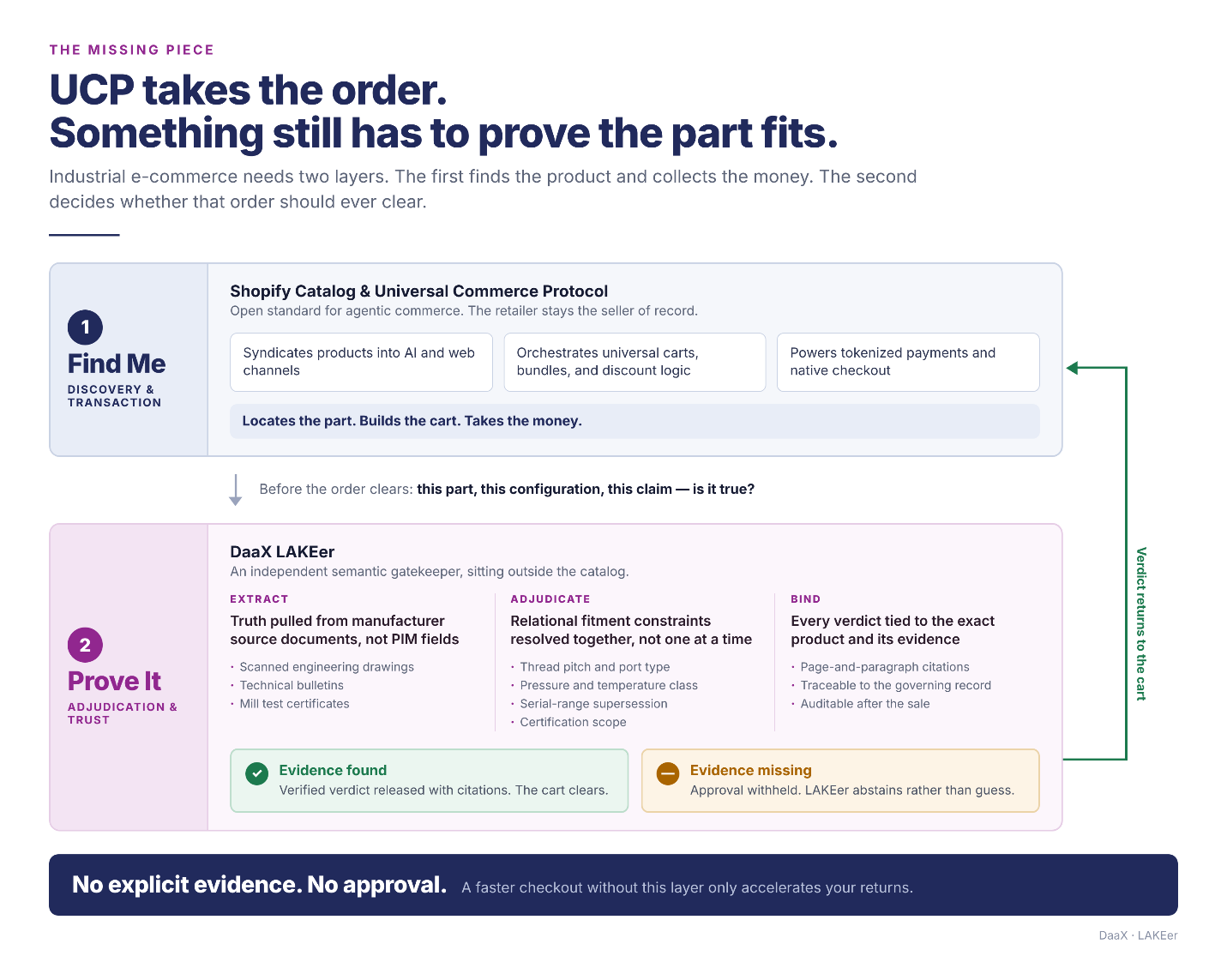
- The “Find Me” layer (Shopify Catalog & UCP). Focuses on discovery, reach, cart management, and payment handshakes. It ensures the buyer can locate a product and pay for it cleanly.
- The “Prove It” layer (DaaX LAKEer). Operates as an independent semantic gatekeeper. Instead of relying on thin PIM data or marketing descriptions, LAKEer adjudicates product claims directly against authoritative manufacturer source documents which include scanned engineering drawings, technical bulletins, and mill test certificates.
LAKEer tests the critical parameters such as thread pitch, pressure class, serial range supersession, and certification scope, and then returns a verified verdict bound to the exact product, complete with page-and-paragraph source citations.
Most importantly, LAKEer is designed to abstain on evidence rather than provide a confident guess. If a manufacturer’s document does not explicitly verify that a part fits a specific configuration, the system withholds approval (flagging the issue for human review), protecting the distributor from shipping a part that does not fit.
Put simply, LAKEer helps customers select the right industrial component the first time, verified against authoritative specifications, compatibility rules, and approved substitutions.
The same verified evidence answers more than “does it fit?” It also resolves three questions that consume quote desk time today:
- Cross-reference verification: Matching legacy SKUs and manufacturer part numbers to the current catalog, so a buyer holding an old part number gets the right item.
- Approved substitutions: Confirming that an alternative part satisfies the documented requirements before it is offered as a replacement.
- Obsolete product replacement: Finding the current, supported equivalent when the original part has been discontinued or superseded.
Human-First Ordering Today, Agent-Ready Tomorrow
Distributors do not need to overhaul their core ERP and PIM systems or rewrite hundreds of thousands of catalog records to solve this.
The winning strategy focuses on human ordering where it matters most:
- Self-service confidence for buyers. Displaying verified fitment badges and manufacturer document citations directly on the product page allows human buyers to verify technical specifications on their own, unlocking high-margin online sales.
- Inside sales enablement. When complex technical inquiries reach the quote desk, CSRs no longer spend 20 minutes digging through PDFs. The system gathers and verifies the relevant documentation in seconds, allowing junior reps to quote difficult categories with the confidence of a 20-year veteran.
- Agentic continuity. By establishing a verified document adjudication layer for human buyers today, distributors automatically future-proof their operations. When autonomous purchasing agents and procurement bots query the catalog via UCP (or similar protocols) tomorrow, the exact same semantic layer ensures they transact against ground-truth engineering data.
The Bottom Line
In high-consequence commerce, fast carts and frictionless checkouts are powerful tools, but they cannot replace domain truth. If your catalog cannot prove that a component fits, a faster checkout only accelerates your returns.
Before you focus on speeding up the transaction pipes, make sure you have the semantic proof to guarantee you never sell a mistake.
If you lead digital commerce, product data, or sales engineering at an industrial distributor, we would like to hear from you. Where do wrong-part orders cost your business the most today? Share in the comments or send me a message.