The Denied Claim: Why Your AI Needs to Be a Detective, Not Just a Reader
How Cross-Document Verification Determines Whether Your IEEPA Refund Survives CBP Scrutiny
A court once denied an importer's refund claim not because the documents were missing — but because there was no reliable way to connect them.
The U.S. Court of International Trade rejected a valuation in Heng Ngai Jewelry v. United States for one reason: it was impossible to match individual payment amounts to the invoices provided. The court called the allocations unverifiable. The claim was denied. Permanently.
That case was decided years before the IEEPA tariff ruling and AI. But it is the most important precedent for AI-assisted trade compliance today — because the same failure mode that sank that importer is being replicated right now by companies using standard AI to build their refund claims.
Today we're talking about cross-document verification — and why the difference between a security guard and a detective determines whether your refund claim survives CBP scrutiny.
The Security Guard Problem
Imagine a security guard at a gate. They check an ID — Document A — and it looks valid. They check a shipping manifest — Document B — and it's formatted correctly. They let the shipment through because both documents, viewed individually, look fine.
This is how standard LLMs and Retrieval-Augmented Generation systems work. They are excellent at reading and retrieving. Ask a standard AI what country of origin appears on your supplier certificate, and it will find the answer. Ask it what HTS code your broker filed, and it will find that too.
What it will not do is reason between the two.
If your supplier certificate says a product originated in Vietnam, but your broker filed an HTS code consistent with Chinese origin, a standard AI sees two separate pieces of data that never meet. No flag. No alert. No cross-document integrity check. Just two correct-looking answers that together constitute a compliance violation.
Foley & Lardner has warned explicitly that discrepancies between ACE data, broker filings, and internal financial systems can delay or undermine refund claims entirely.
This is not a theoretical risk. It is the documented failure mode of systems that retrieve without verifying.
LAKEer's 3D Graph
LAKEer doesn't read your documents in isolation. It builds a 3D Graph — an ontology-driven knowledge graph that links entities across document boundaries.
Think of it as a detective's investigation board, where red strings connect different pieces of evidence. Your supplier certificate and your broker's customs entry are not two separate files. They are two nodes in the same graph, connected at the entity level.
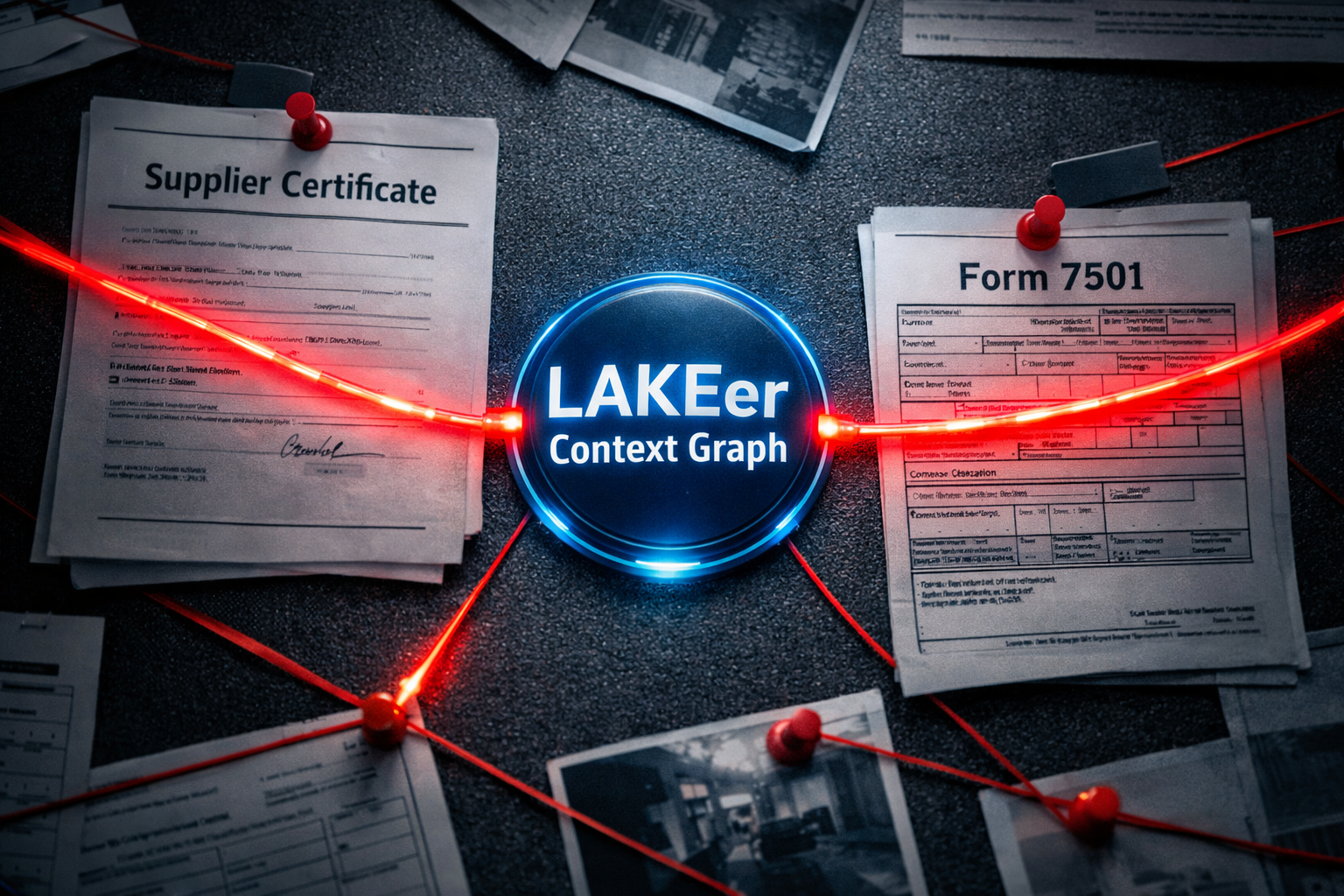
Here is what that means in practice for IEEPA refund claims:
- Entity linking: LAKEer identifies that the component on your supplier certificate is the same component in your CBP Entry Summary (Form 7501). Same product, different documents, one verified relationship.
- Structural visibility: Country of origin from the certificate and HTS code from the broker filing are mapped onto the same branch of the graph. Any conflict becomes structurally visible — not a probabilistic guess.
- Automated verification: Because these data points are neighbors in the architecture, LAKEer does not miss the inconsistency. It flags it, traces it, and surfaces it with full provenance.
This is exactly the cross-document verification that WilmerHale says is required for a successful refund claim: a complete, linked paper trail connecting entry packets — CF-3461, CF-7501, commercial invoices, packing lists, certificates of origin — to proof of duty payment.
The Heng Ngai ruling was not about bad faith. It was about unverifiable linkage. The court did not say the payments didn't happen. It said they could not be matched to the invoices. That is a cross-document integrity failure — and it is exactly what standard AI produces when it retrieves without verifying.
The difference is not incremental. Standard LLM-RAG systems are built to retrieve — to find text that looks relevant. LAKEer is built to verify — to confirm that what it found is correct and traceable to source. In a CBP audit or CIT protest, that architectural distinction is the difference between an accepted claim and a permanently forfeited one.
Ready to Learn More?
Schedule a call with our engineers to see how LAKEer's cross-document verification protects your IEEPA refund claims.
Talk to an Engineer (15 min)