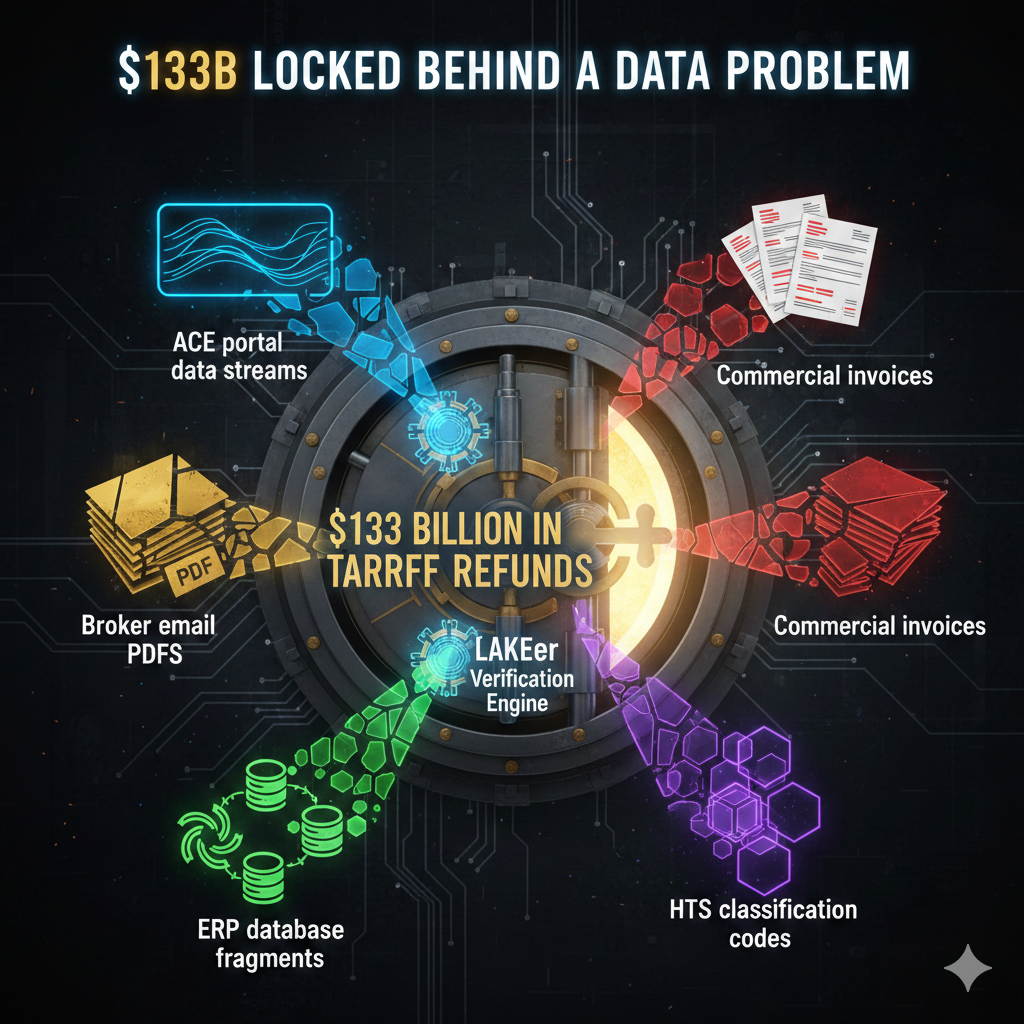
When the Supreme Court struck down the IEEPA tariffs in Learning Resources, Inc. v. Trump, trade compliance teams across the United States exhaled. Billions of dollars in duties, collected since 2025 under emergency trade authority, were suddenly in question. Importers who had absorbed those costs — passed them through their supply chains, buried them in pricing, or simply paid them and moved on — faced the prospect of recovering funds they had written off. The legal victory was real. What followed it was not a refund. It was a deadline and a data problem.
To recover IEEPA duties, an importer must prove — document by document — precisely what was paid, when it was liquidated, under which HTS codes, and whether the goods in question were actually subject to the tariffs. They must do this within 180 days of the liquidation date. And the documents required to make that case were never designed to be audited.
This article is not about the legal strategy for protest filings. Trade attorneys are well-equipped to guide that process. This article is about the specific, underappreciated problem that sits upstream of every legal argument: the data that must be assembled before a lawyer can draft the first paragraph of a protest. For mid-market importers — companies with $1 million to $10 million in IEEPA tariff exposure (an amount, as trade compliance analysts describe it, large enough to materially impact EBITDA and stock valuation, but small enough that these companies lack a dedicated internal trade compliance team — making the 180-day window a survival event, not a routine administrative task) — that data problem may be more consequential than the legal strategy itself.
The Documents You Need Are Not Where You Think They Are
Every duty refund protest ultimately rests on a paper trail. That trail runs through CBP Form 7501 entry summaries, commercial invoices, packing lists, certificates of origin, bills of lading, and in complex cases, component-level bills of materials and material breakdown data for multi-part products.
Most enterprise importers assume, reasonably, that this documentation lives somewhere in their systems. In practice, it almost never does — at least not in any form that supports the granular, cross-document analysis that a protest filing requires.
Here is the structural problem, which we see repeatedly in conversations with procurement and legal teams:
Customs documentation is generated at the point of entry, managed by third-party brokers, and stored — if it is stored at all — in broker systems, email attachments, and ACE portal exports that are rarely integrated with the company's ERP. A large importer working with fifteen or twenty customs brokers globally has fifteen or twenty different data environments, each with its own formats, fields, and completeness standards. There is no unified record of liquidated entries. There is often no unified record of which HTS codes were filed. JD Gonzalez, president of the National Customs Brokers and Forwarders Association of America, has described an environment in which guidance is sometimes murky and each new policy announcement forces brokers to scramble to dissect rules, update systems, and notify clients with shipments already en route — a characterization that underscores why importer data landscapes look different across every broker relationship in their portfolio.
For companies importing complex products — electronics, industrial equipment, machinery with multi-layer bills of materials — the problem compounds. A single imported product assembly may contain hundreds of sub-components classified under different HTS codes. Some of those codes begin with 9903.01 or 9903.02, the IEEPA-specific prefixes that determine eligibility for refund. Others do not. Reconciling actual tariff exposure to the component level requires data that lives in technical drawings, MRO records, and supplier invoices — none of which appear on the standard commercial invoice, and none of which were ever integrated into the systems that procurement teams actually use.
Suppliers created an additional layer of complexity when the tariffs were first imposed. Some added explicit tariff surcharge line items to their invoices. Others simply absorbed the cost into base pricing to preserve the integrity of their electronic data interchange documents. Stanford University's procurement guidance on tariff impacts captures the scope of the problem, warning buyers that suppliers may add tariff-related fees not included in initial quotes, with final charges remaining unclear until the shipment date. Trade press coverage reports that products now commonly face two, three, or even five separate tariff lines, turning what were previously straightforward duty calculations into layered surcharge structures that appear inconsistently across different supplier invoices.
For procurement teams now trying to reconstruct the original cost basis of entries filed eighteen months ago, this means parsing conflicting invoice structures across dozens of supplier relationships — from documents that were never standardized and were never meant to be compared against each other.
This is what we call the dark data problem: information that exists somewhere in the enterprise, but exists in forms that are inaccessible to query, analysis, or verification.
Why Legal Teams Face a Verification Problem, Not Just a Data Problem
Legal teams working on IEEPA protest filings face a specific requirement that distinguishes this work from ordinary document review: every claim in a protest must be backed by an immutable audit trail.
CBP and the Court of International Trade evaluate protests with precision. A mismatch between a certificate of origin and the HTS code filed on Form 7501 is not a minor inconsistency — it is a ground for rejection. An invoice that cannot be reconciled to the corresponding entry summary is not useful evidence — it is a gap in the record. An "audit-ready bundle" that groups commercial invoices, packing lists, and entry summaries must be accurate, verifiable, and internally consistent.
The 180-day protest window is not a soft deadline. Missing it — for any entry — permanently bars recovery of those duties. The scale of what is at stake is significant: the Cato Institute, drawing on CBP data, reports that IEEPA tariffs were collected from approximately 301,000 U.S. importers across 34 million entries. Yale's Budget Lab estimates roughly $142 billion in IEEPA-authority tariffs collected in 2025 alone, with Penn Wharton models putting cumulative collections through early 2026 north of $175 billion. Tim Brightbill, co-chair of Wiley Rein's International Trade Practice Group, has stated that the Supreme Court ruling could lead to the refund of hundreds of billions of dollars in tariff revenue.
More than 2,000 lawsuits have already been filed at the Court of International Trade, with the Department of Justice expecting thousands more. The historical precedent is instructive: when the Supreme Court struck down the Harbor Maintenance Tax on exports in United States v. United States Shoe Corp., 523 U.S. 360 (1998), the government did not issue automatic refunds. Only companies that had filed timely administrative claims recovered their payments. The same statutory framework governs IEEPA tariff refunds — making the integrity of every filing a direct determinant of recovery.
The problem is not finding documents. It is verifying that the claims those documents support are internally consistent — and will withstand CBP scrutiny.
The Problem with Generic AI for Legal-Grade Document Work
There is a category of AI that has become standard in enterprise knowledge management: retrieval-augmented generation, or RAG. In a typical RAG system, documents are converted into numerical representations called embeddings, stored in a vector database, and retrieved by semantic similarity when a user poses a question. The language model then generates a response based on the retrieved content.
For many enterprise use cases, this approach is effective and appropriate. For customs compliance work that must meet CBP and CIT standards, it introduces a specific and serious risk.
Vector similarity retrieval finds text that is semantically similar to a query. It does not verify whether the claim that text supports is accurate. It does not cross-reference a certificate of origin against the HTS code on an entry summary. It does not flag an anomaly when a supplier invoice uses a different tariff classification than the one filed by the broker. It retrieves. It does not verify.
The consequence is that AI-generated outputs from standard RAG systems are, by construction, unverified claims. In a low-stakes context — summarizing an internal report, answering a question about company policy — an unverified claim that is mostly correct is often acceptable. In a formal protest filing with CBP, an unverified claim that is mostly correct is a liability. A hallucinated invoice grouping, a confident but incorrect cross-reference, or a missed anomaly between documents could constitute a false or inaccurate filing.
The legal standards governing this are clear and unforgiving. Trade attorney Jeff Chang of Chang Law Group is unambiguous: protests must comply with the format and content requirements of 19 CFR Part 174, and procedural deficiencies can result in denial regardless of the merits. A rejected protest means permanently forfeiting refund rights regardless of the amount at stake. Industry research on the IEEPA unwind reinforces the technical dimension of this risk: standard AI models often lack the precision required for legal filings, and the standard CBP applies — reasonable care under 19 U.S.C. section 1484 — holds importers accountable for the accuracy of submitted data regardless of the tools used to produce it.
The distinction that matters here is not between AI that is "good" and AI that is "bad." It is between AI that retrieves and AI that verifies.
The Court of International Trade's decision in Heng Ngai Jewelry, Inc. v. United States (Slip Op. 04-28, 2004) illustrates what this failure mode looks like in practice. CBP rejected the importer's claimed transaction value and applied computed value because the documentation submitted — invoices, financial statements, cost breakdowns — was internally inconsistent and failed to corroborate the asserted sale price and general-expense components. CBP issued multiple CF 28 requests; the importer's responses were incomplete or contradictory relative to the invoices and drawback claims filed. The court found a genuine issue of fact as to whether the importer had used reasonable care in furnishing documentation — affirming that CBP's rejection was grounded in deficiencies in the documentary record, not in the underlying facts of the transaction.
The mechanism of failure in that case — inconsistent data across related documents, an inability to reconcile claimed values to supporting records — is precisely the failure mode that unverified AI output introduces at scale. An AI system that retrieves documents and generates summaries without cross-referencing them will not catch a drawback claim that omits a profit component present in the corresponding import invoice. It will not flag a cost breakdown that contradicts a financial statement submitted earlier. These are the inconsistencies that trigger CF 28 requests, computed-value appraisements, and permanent forfeiture of refund rights.
What Verification-First Document Intelligence Looks Like
At DaaX, we built LAKEer around a different architecture. The core principle is that language model outputs should be treated as hypotheses — not answers. The verification layer exists to evaluate those hypotheses against structured evidence before anything is presented as a finding.
In practice, this means several things for customs compliance work specifically. When LAKEer processes a corpus of customs documents — entry summaries, invoices, certificates of origin, broker correspondence — it does not treat those documents as flat text to be retrieved by similarity. It structures them as a 3D graph: facts at the instance level, rules and classifications at the conceptual level. When a question is posed, the answer is checked against that graph. Cross-document inconsistencies are surfaced as anomalies, not suppressed by averaging.
For IEEPA refund work, this means the system can flag a mismatch between a certificate of origin and an HTS classification before that mismatch reaches a legal filing. It means an audit bundle can be assembled with evidence that every element has been cross-referenced, not just retrieved. It means the output carries what we call proof and provenance: every claim is traceable to a source document, and every source document is traceable to the claim it supports.
This is the difference between AI that the business will use and AI that the compliance team will approve. In enterprise settings — and especially in legal-grade document work — that distinction is not semantic. It determines whether the output is useful or dangerous.
What Procurement and Legal Teams Should Do Now
For companies assessing their position before the 180-day protest windows close, the immediate priorities are practical rather than strategic.
1. Inventory
Identify the full universe of entries where the company served as importer of record during the period IEEPA tariffs were in effect, pull liquidation dates for each entry, and map the 180-day deadlines. This is a data pull from CBP's ACE portal combined with broker records — and it is typically the first moment companies discover how fragmented their customs data actually is.
2. Document Assembly
Gather not just entry summaries but the full evidentiary chain — commercial invoices (including component-level where applicable), packing lists, certificates of origin, and proof of payment. This is where the dark data problem becomes acute. For any company that has not proactively maintained this documentation, the assembly process is a retrieval exercise across broker emails, shared drives, legacy systems, and in some cases paper records.
3. Verification
Confirm that the assembled documentation is internally consistent, flag anomalies before they reach a legal filing, and produce output that meets CBP's audit standards. For the first two tasks, any competent process will suffice. For the third, the architecture of the AI system is the product.
Enterprise AI that retrieves is a productivity tool. Enterprise AI that verifies is infrastructure. The IEEPA refund window is, among other things, a test of which one your organization has.
A Note on the Data Checklist
We have published a structured checklist of every document category relevant to IEEPA duty refund protests, with notes on why each category is harder to assemble than it appears and what to watch for in the verification process. It is available for download without a form — because we believe the most useful thing we can do for trade compliance teams right now is give them accurate, actionable information as quickly as possible.
If you are working through the documentation requirements for IEEPA protests and want to understand what verification-first document intelligence looks like for customs data — including how LAKEer structures and cross-references heterogeneous customs documents — we are offering complimentary 20-minute architecture consultations through the end of Q1 2026.
The 180-day window is a hard constraint. The data problem it has created is solvable. The question is whether the tools being used to solve it can meet the evidentiary standard the solution requires.
LAKEer is DaaX's enterprise knowledge intelligence platform. It transforms unstructured dark data into verified, domain-aware intelligence — with full proof and provenance for every answer it produces. LAKEer is used by enterprise procurement, legal, and operations teams that cannot afford the cost of confident-but-wrong AI outputs.
We're offering complimentary 20-minute architecture consultations through the end of Q1 2026.
Contact us →Note: This content is informational only. DaaX is not a law firm and does not provide legal advice. Nothing here should be construed as legal counsel regarding your company's specific refund eligibility, filing obligations, or CBP compliance posture. Retain qualified trade counsel before taking any action.
Damon Miller