A manager at a German firm asks an AI to pull competitor profit-margin figures for a board presentation. The system delivers them a precise, well-formatted and completely wrong result. When the manager asks the AI to verify against actual reports, it keeps making numbers up. Across the Atlantic, a U.S. researcher spends weeks building on AI-generated analysis before discovering what they later describe as "a large, slow hallucination — answers that were internally consistent, confident, and wrong in subtle but compounding ways."
These are not isolated incidents. They are data points from the largest qualitative study of AI users ever conducted.
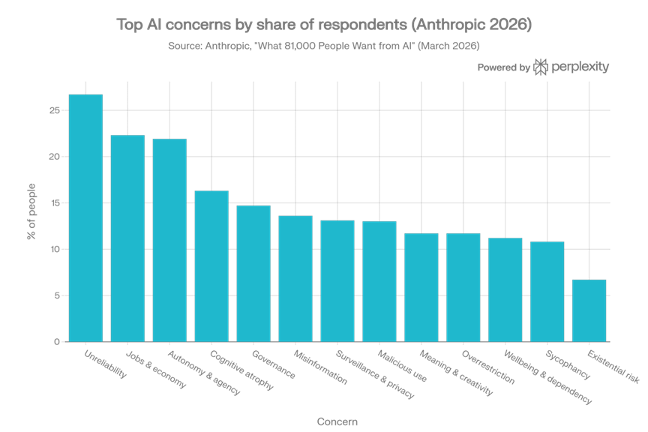
In March 2026, Anthropic published findings from ~81,000 interviews conducted across 159 countries and 70 languages. The headline finding: unreliability is the #1 concern among AI users, cited by 26.7% of respondents, ahead of job displacement (22.3%), privacy and every other concern tested. The report defines unreliability as encompassing hallucinations, inaccuracy, fabricated citations, and the verification burden placed on users.
For enterprise and government leaders deploying AI against internal data such as contracts, financial records, compliance documents, and technical specifications, this finding is not surprising. It is confirmation.
Why Unreliability Happens: The Architecture Behind the Problem
The unreliability that Anthropic's study documents is not a bug waiting to be patched. It is a structural feature of how large language models work.
LLMs are coherentist systems: they generate text that is statistically consistent with their training data, not text that is verified against a ground-truth source. When an LLM retrieves from your enterprise documents such as your contracts, your financial reports, and your compliance records it does not look up facts. It predicts the most plausible-sounding response given the context. The result can be confident, fluent, and completely fabricated.
This matters especially in the enterprise context because the stakes are asymmetric. A consumer asking an AI for a recipe recommendation can ignore a wrong answer. A lawyer citing a fabricated case, a financial analyst presenting false competitor margins, or a compliance officer relying on an inaccurate regulatory summary cannot.
Why Existing Solutions Fall Short: Retrieval Is Not Verification
RAG is retrieval. It is not verification. These are not the same problem.
The standard enterprise response to hallucination has been Retrieval-Augmented Generation (RAG): feed the LLM relevant documents so it has better context before generating a response. RAG reduces some hallucination. It does not eliminate it, and it does not solve the deeper problem.
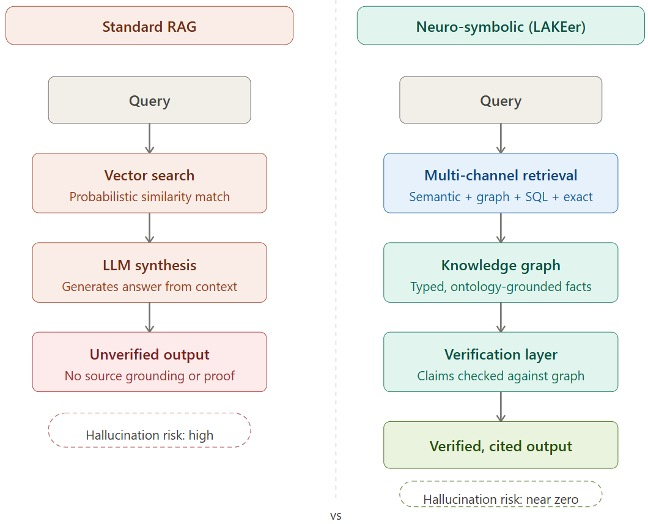
RAG systems retrieve but do not verify. They surface documents that are semantically similar to the query using probabilistic vector similarity but they cannot confirm whether the LLM's synthesized answer actually reflects what those documents say. The LLM still interpolates, still infers, still confabulates. And because the output sounds authoritative and cites real sources, users are less likely to question it.
"An assistant that sounds sure but is often wrong forces you to treat everything as suspect. Instead of freeing attention, it creates a permanent 'fact-check tax.'"
Another respondent put it plainly: "If AI saves me time, it's also so I don't have to verify its answers." The productivity promise of enterprise AI — for example faster decisions, better analysis, and reduced manual work — collapses when every AI-generated output requires a human to verify it. That verification burden is precisely what users are reporting as their #1 concern.
A Better Approach: From Retrieval to Verified Knowledge
The solution to the unreliability problem is not a better LLM. It is a different architecture that separates retrieval and verification from synthesis, and treats them as distinct engineering problems.
This is the architectural shift that neuro-symbolic knowledge platforms like DaaX represent: moving from probabilistic vector search to deterministic, ontology-guided retrieval with every claim backed by provenance (where it came from), proof (how it was established), and context (under what conditions it holds).
The distinction matters in practice. A traditional RAG system is like asking a well-read but occasionally forgetful colleague to answer from memory — fluent, plausible, and unverified. A verified knowledge system requires that colleague to retrieve the exact document, cite the specific passage, and have a second system confirm the answer matches what the source actually says. The output is trustworthy by design, not by chance.
How Verified Knowledge Systems Work: A Step-by-Step Workflow
Consider a compliance team asking: "What are our contractual obligations to Supplier X under the 2023 master agreement, and do any of our recent purchase orders conflict with those terms?" In a standard RAG environment, this query returns the most semantically similar document chunks. In a verified knowledge architecture, it triggers a structured pipeline:
- Ingestion: Contracts, POs, and supplier records are parsed and classified with tables routed to structured query, text to semantic embedding, and entities extracted to the knowledge graph.
- Linking: Entity resolution maps "Supplier X" to a single node in the knowledge graph, resolving references across 14 separate POs into one authoritative identity.
- Multi-Channel Retrieval: Six parallel channels — semantic search, exact entity match, structured SQL queries on tabular data, and graph traversal — retrieve evidence from multiple angles simultaneously.
- Verified Output: The LLM generates the final response. A verification layer cross-references every specific claim against the knowledge graph. Only graph-supported claims are included; unsupported inferences are flagged or discarded.
What This Means for Enterprise AI Deployments
The Anthropic findings have a direct commercial implication: mission-critical AI deployments cannot run on systems that require humans to verify every output. The verification burden is operational drag and legal exposure and in enterprise-grade deployments, neither is acceptable.
The study notes that the verification burden is especially acute in law, finance, government, and healthcare, precisely the domains where AI adoption offers the highest value but hallucinated outputs carry the greatest risk. As one respondent from the legal sector noted: when a regulator or counterparty asks "how do you know this?", "the model generated it" is not a defensible answer.
Verified knowledge architectures change this calculus across three dimensions:
- Risk reduction: Every claim traces to a specific source document. The audit trail is structural, not assembled after the fact.
- Productivity recovery: Eliminating the fact-check tax restores the time savings that enterprise AI was supposed to deliver.
- Compliance defensibility: In regulated industries, verified outputs with documented provenance chains are the difference between an AI system that helps and one that creates liability.
LAKEer by DaaX Technologies
LAKEer is a Computational Knowledge Agent designed to solve enterprise AI unreliability using a neuro-symbolic architecture that combines automated content graph construction, pluggable domain and company knowledge, and a multi-layer verification pipeline to provide provenance, proof, and context for every AI-generated claim.
On Google DeepMind's FACTS Grounding benchmark, LAKEer achieved a leading score of 77.7 — exceeding Gemini 2.5 Pro's published 74.3 score.
Strategic Takeaway
The Anthropic study provides something that AI vendors rarely encounter: unambiguous, large-scale user data confirming that trust, and not capability, is the defining competitive dimension in enterprise AI. The organizations that solve the unreliability problem architecturally, rather than hoping better LLMs will eventually self-correct, will define what enterprise-grade AI looks like in the next decade.
In a market where every AI vendor promises accuracy, the differentiator is proof. Not confidence. Proof.
The question for every enterprise AI deployment is no longer "how fast can it answer?" It is "how do you know the answer is right?"
Additional DaaX.ai Resources
- "Computational Knowledge and Reasoning: From Plato to Production Systems"
- "What's Missing in AI for Enterprise Search? Domain Knowledge and Company Language"
- "How LAKEer's Neuro-Symbolic Architecture Achieves 77.7 on the FACTS Benchmark"
Source: Anthropic, "What 81,000 People Want from AI," March 2026 — anthropic.com/features/81k-interviews
BibTeX Citation
@online{huang2026interviewer,
  author = {Saffron Huang and Shan Carter and Jake Eaton and Sarah Pollack and Dexter Callender III and Nikki Makagiansar and Maria Gonzalez and Sylvie Carr and Jerry Hong and Kunal Handa and Miles McCain and Thomas Millar and Mo Julapalli and Grace Yun and AJ Alt and Chelsea Larsson and Jane Leibrock and Matt Gallivan and Theodore Sumers and Esin Durmus and Matt Kearney and Judy Hanwen Shen and Jack Clark and Michael Stern and Deep Ganguli},
  title = {What 81,000 People Want from AI},
  date = {2026-03-18},
  year = {2026},
  url = {https://anthropic.com/features/81k-interviews},
}